

Trust in news is collapsing, and it is collapsing fastest in the United States. The Reuters Institute Digital News Report 2026, released this week, found that only 37 percent of people globally and just 25 percent of people in the United States say they trust most of the news most of the time, the lowest readings since the institute began tracking the metric in 2015. The US figure fell five points. In one year. The same report documented social and video networks overtaking television as the primary news source globally for the first time. For public relations firms, two load-bearing assumptions just gave way at once.
Top 3 Takeaways
1. Trust Is Now a Scarcer Commodity Than Ever
The Reuters Institute in 2026 reports global trust at 37 percent and US trust at 25 percent, both the lowest readings on record since 2015. PR firms operating on assumptions of moderate baseline trust must recalibrate their crisis playbooks for an audience that defaults to skepticism, especially in the United States, where Fox News and CBS News each lost 10 points of brand trust in a year.
2. Owned Media Loses Its Anchor Position
For the first time, social and video networks outrank both television and owned news websites as the primary news source. The press-release-to-legacy-outlet path no longer reaches the largest segment of the global news audience.
3. AI Chatbots Are a Channel, Not a Side Conversation
Ten percent of global audiences and 16 percent of under-35s use AI chatbots for news weekly. PR strategies that ignore generative-engine optimization cede a measurable share of audience visibility.
Trust in News Hits Lowest Recorded Level
Eleven years of measurement. One trend line. The 37 percent global trust figure marks a three-point drop from the previous year, and the 25 percent US figure marks a five-point drop. Both are the lowest readings in the period the Reuters Institute has tracked the metric. Fox News and CBS News each lost 10 points of brand trust over the same year, an unusually large single-year contraction for established US news brands. The report, authored by Nic Newman, Senior Research Associate at the Reuters Institute for the Study of Journalism at the University of Oxford, frames the decline as part of a longer pattern in which “convenience appears to trump concern” for news audiences who increasingly rely on less-trusted third-party sources.
The Edelman Trust Barometer 2026 reinforces the trajectory. Edelman reported that distrust of major institutions has held above 50 percent for a third consecutive year. Read together, the two data sets suggest something structural rather than cyclical. Audience skepticism is no longer a phase. It is the floor, adding to the long-running pressure on agency trust that PRUSA has tracked through 2024 and 2025.
For PR firms, the trust collapse compresses the window in which earned media can shift audience perception. Crisis-response playbooks built for a 50-percent-baseline trust audience overestimate how much a single well-placed media hit can move sentiment. Agencies are responding by adding source-corroboration requirements to client-side approval workflows. They are also stress-testing message claims against the same skepticism standards that investigative reporters apply, the kind of internal pre-mortem that two years ago would have looked like overreach.
Social and Video Networks Now Outrank Television
54 percent. That is the share of global audiences now using social and video networks as a primary news source, according to the 2026 report. The figure exceeds both television news at 52 percent and news organizations’ own websites and apps at 51 percent. The report identifies the crossing as the first time platform sources have outranked both legacy categories simultaneously.
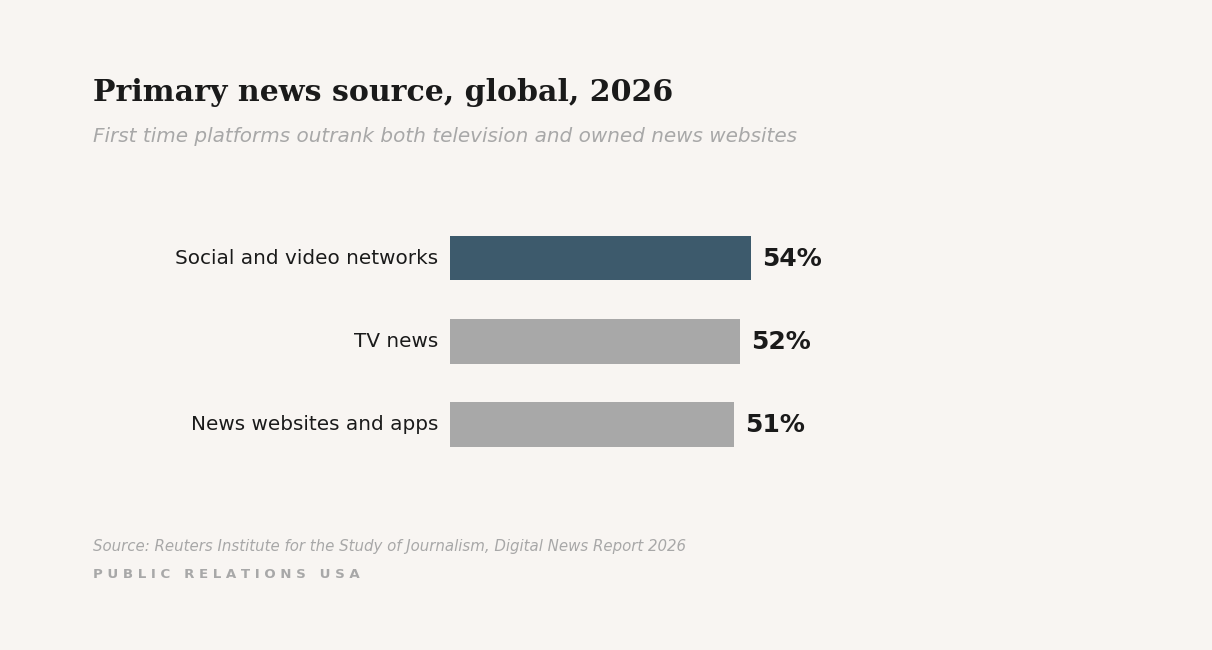
The shift forces a structural change in distribution strategy. Press releases targeted at legacy newsroom desks reach an audience shrinking in both absolute and relative terms. Communications teams that built earned-media programs around morning-show pickup and front-page placement now face the question of whether the same effort directed at platform-native creators yields measurably more reach. The answer is increasingly yes.
For PR firms, traditional press-release distribution to legacy outlets reaches a shrinking share of the audience, and platform-native pitching becomes the load-bearing channel. Agencies are restructuring. Several large holding-company shops have rebuilt their pitch databases to include creator contacts alongside journalist contacts, and dedicated platform-relations leads now sit inside media-relations teams that twelve months ago would not have included the role.
Creator-Class Coverage Crosses the Mainstream Threshold
46 percent of global audiences get news from creators of any type. 27 percent specifically follow news-focused creators. The figures cross what trade observers have informally called the mainstream threshold, the point at which a channel can no longer be dismissed as a niche supplement to traditional media.
The implication is operational. Pitch lists that exclude creators omit a measurable share of the audience that influences client perception. Talent-relations workflows built only around accredited reporters miss the channel where more than a quarter of audiences encounter news. The compositional question for agency leadership is whether the talent-relations function should sit inside media relations or as a parallel team with its own metrics and budgets.
For PR firms, the talent roster for media outreach must now include creators alongside reporters. The vetting protocol is different. Creator partnerships require disclosure compliance, brand-safety review, and audience-authenticity verification as standard pre-engagement steps, and several of the major holding-company shops have begun publishing creator guidelines that resemble the editorial standards memos newsrooms post for their own staff.
AI Chatbots Become a Measurable News Channel
Ten percent. That is the share of global audiences now using AI chatbots for news weekly, the 2026 report found, up from 7 percent a year earlier. Among audiences under 35, the share is 16 percent. Adoption rates suggest continued growth as generative-engine usage normalizes across professional and consumer settings.
The channel behaves differently from search and social. AI chatbots surface answers, not links, and the sources they cite depend on factors that do not map cleanly to traditional SEO or media-relations practice. Communications teams have begun investing in what some practitioners call generative-engine optimization, a discipline that focuses on the authority signals generative models use when they construct cited responses to user questions about brands, executives, and industry events.
For PR firms, message visibility in AI answers requires source authority signals the chatbots index, not just reporter relationships. Practical work has started. Structured-data publication on client owned media, deliberate cultivation of Wikipedia and Wikidata entity coverage, and earned-media placement in sources that generative models cite at higher rates are now standard line items in client retainer plans, though the transition is uneven across the agency landscape. AI’s growing role in communications workflows is still treated as experimental in many shops.
What the Next Ninety Days Demand
The trajectory will not reverse in 2026. Crisis playbooks built for the old baseline now need new floors. Agencies that have already added creator-relations leads, deployed structured-data publication on client sites, and rebuilt internal claim-corroboration protocols enter the second half of 2026 with a different competitive profile than those still pitching to mastheads as the primary channel. The work is operational, not aspirational, and the cost of waiting compounds quickly as platform and AI channels consolidate audience attention.